What refinishing fixes, and what it does not
Refinishing deals with the surface: dull or worn glaze, stains that will not scrub out, chips, scratches, rust spots where the metal shows, and dated colors. Chips are filled and sanded flush, rust is ground back and sealed, and the whole surface is cleaned, etched or sanded, primed and coated.
It does not fix structure or plumbing. A crack through a cast-iron tub, a steel tub rusted through at the drain, a fiberglass tub that flexes and cracks underfoot, or a leak under the tub all need repair or replacement. A refinished surface is also a coating on top of the old one: it can look very like new glaze but is softer, so it needs gentler cleaning.
Which tub do you have?
The material changes the prep and the limits. A magnet sticks to cast iron and steel through the enamel, but not to fiberglass or acrylic.
- Enameled cast iron: very heavy and rigid, the most common original tub in prewar houses. Usually an excellent candidate unless cracked.
- Enameled steel: lighter, sounds hollow when tapped, and can rust through at chips near the drain. Refinishable if the metal is sound.
- Fiberglass: common in remodels and newer houses. Cracks can be repaired, but a tub that flexes needs support underneath first.
- Acrylic: a solid-color shell, often over fiberglass. Takes a different bonding primer; ask the refinisher whether they work on acrylic.
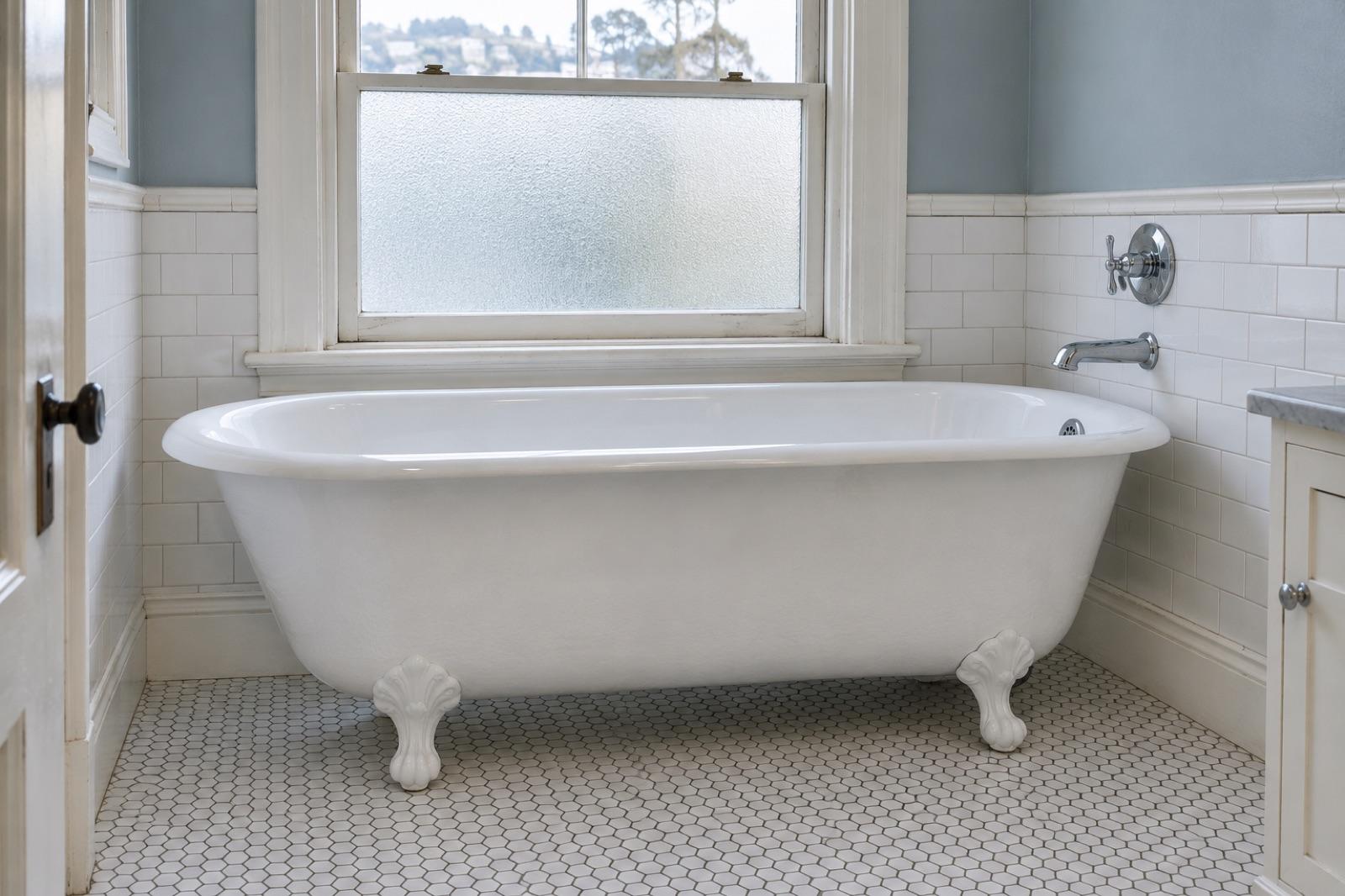
- Clawfoot: usually cast iron with porcelain inside and painted outside. See the separate clawfoot guide for the outside and feet.
How old is the bathroom?
Housing age varies sharply across the region, and it tells you what kind of tub is likely in place. In the Census Bureau’s 2024 American Community Survey, about 49 percent of Berkeley’s housing, 45 percent of San Francisco’s and 39 percent of Oakland’s was built in 1939 or earlier. Those cities have many built-in cast-iron tubs boxed in by tile, where refinishing avoids tearing out the walls.
Further out the housing is younger. About 64 percent of Concord’s housing dates from 1950 to 1979, half of Walnut Creek’s from the 1960s and 1970s, and about 40 percent of San Jose’s from the same two decades. Bathrooms there are more likely to have an original steel or cast-iron tub or a fiberglass unit from a later remodel.
Water hardness differs across the Bay
Mineral scale has to come off completely before any coating will bond, and hard water leaves more of it. San Francisco’s water is soft: the SFPUC’s 2025 report gives hardness of 8.1 to 112 ppm, averaging 62. EBMUD, which serves much of the East Bay including Oakland and Berkeley, gives a range of about 1 to 7 grains per gallon. San Jose Water lists 11 to 26 grains per gallon for its groundwater and 4 to 12 for its surface supplies, and treats more than 7 grains as hard.
In harder-water areas, a refinished tub lasts longer if it is wiped dry and cleaned with non-abrasive products, because scrubbing scale off with abrasive pads wears the coating.
Apartments, condos and renters
Much of the region rents: about 63 percent of occupied homes in San Francisco, 56 percent in Oakland and 54 percent in Berkeley (ACS 2024). Renters need the owner’s approval. In condo buildings, check association rules on contractor hours, elevators and parking, and plan how fumes will be vented from small interior bathrooms.
Fumes, strippers and lead
Etching products, strippers and coatings give off strong fumes. Professional refinishers normally set up an exhaust fan vented outdoors and wear respirators. Ask how they will ventilate, what stripper they will use if an old coating has to come off, and how long the room should stay unused for their product. The EPA links methylene chloride, a paint-stripping chemical, to deaths among bathtub refinishing workers. Paint strippers containing it have been banned from consumer sale since 2019, but a 2024 rule that would have ended most commercial uses was vacated by a federal appeals court in September 2026, so it is worth asking which product a contractor uses.
In a home built before 1978, painted walls, trim or a painted tub exterior may contain lead. Contractors who disturb more than six square feet of painted surface in a room must be certified under the EPA’s Renovation, Repair and Painting rule. For anything health-related, rely on the EPA’s guidance rather than this page.
How long it lasts
This Old House says a refinished surface can last at least 10 years with proper care. Fixr says most last 8 to 10 years, and up to 15 when well maintained. Good surface prep, letting the coating cure fully as the refinisher directs, and non-abrasive cleaners all help.
What affects the price
Beyond the published ranges above, these are what move a quote:
- Tub material and size, and whether it is a clawfoot with an exterior to paint
- Number of chips, rust spots or cracks to repair
- Stripping a previous coating that is peeling
- Adding the wall tile or surround to the same visit
- Access: stairs, parking and building rules
- Lead-safe work if painted surfaces will be disturbed in a pre-1978 home
When replacement is the better call
Replace the tub if it is cracked or rusted through, if the base leaks, if you want a different size or a walk-in shower, or if the bathroom is being gutted anyway. If a tub has been refinished several times and the coating keeps failing, a full strip or replacement is usually cheaper in the long run than another coat.
Frequently asked questions
Is it cheaper to refinish or replace a bathtub?
Refinishing is usually far cheaper. National guides put it at roughly $335 to $650, against $1,400 to $10,500 (This Old House) or $5,000 to $7,000 (Fixr) to replace.
Can a chipped bathtub be repaired without refinishing the whole tub?
Often. Small chips can be filled and color-matched as a spot repair, though a perfect match on old glaze is not guaranteed.
Can a fiberglass tub be refinished?
Yes. Cracks are repaired and the surface recoated. A tub that flexes underfoot needs support first or the crack returns.
Does hard water affect a refinished tub?
Scale must be removed before refinishing. Afterwards, wipe the tub dry and avoid abrasive cleaners, which wear the coating.
Who does the work?
Independent local refinishers. This site passes your request to them; it does not employ a crew.
Sources and further reading
- This Old House: Bathtub Refinishing Cost (2026 guide, updated 03/17/2026)
- Fixr: Bathtub Refinishing Cost (updated February 6, 2025)
- U.S. Census Bureau, American Community Survey 2024 1-year: Year Structure Built (B25034), Units in Structure (B25024) and Tenure (B25003), via Census Reporter
- San Francisco Public Utilities Commission: 2025 Annual Water Quality Report, City of San Francisco
- East Bay Municipal Utility District: water quality FAQ, water hardness in grains per gallon
- San Jose Water: Water FAQs (hardness by supply source)
- U.S. EPA: Lead (protect your family, renovation guidance)
- U.S. EPA: Lead Renovation, Repair and Painting (RRP) program
- U.S. EPA: Risk management for methylene chloride (2019 consumer ban; 2024 rule vacated September 2026)