Marble: etching is not a stain
Dull, rough marks where lemon juice, wine, vinegar or an acidic cleaner sat on marble are etches: the acid has reacted with the stone’s surface. LATICRETE’s STONETECH guidance says penetrating sealers protect against water- and oil-borne stains but cannot protect against etching, and that etching can only be properly repaired by mechanically refinishing the damaged area. That is honing and repolishing work for a stone restorer.
Stains are different: they are absorbed into the stone and may be drawn out with a poultice. A restorer can tell the two apart in person.
Granite: chips, seams and sealing
Chips along the sink and dishwasher edges are the most common granite repair. A restorer fills them with color-matched resin and polishes them flush; the repair is usually hard to spot but not invisible. Seams that have opened can be cleaned out and refilled. Dark patches that appear when water sits mean the stone is absorbing and may need resealing; a simple water test shows it.
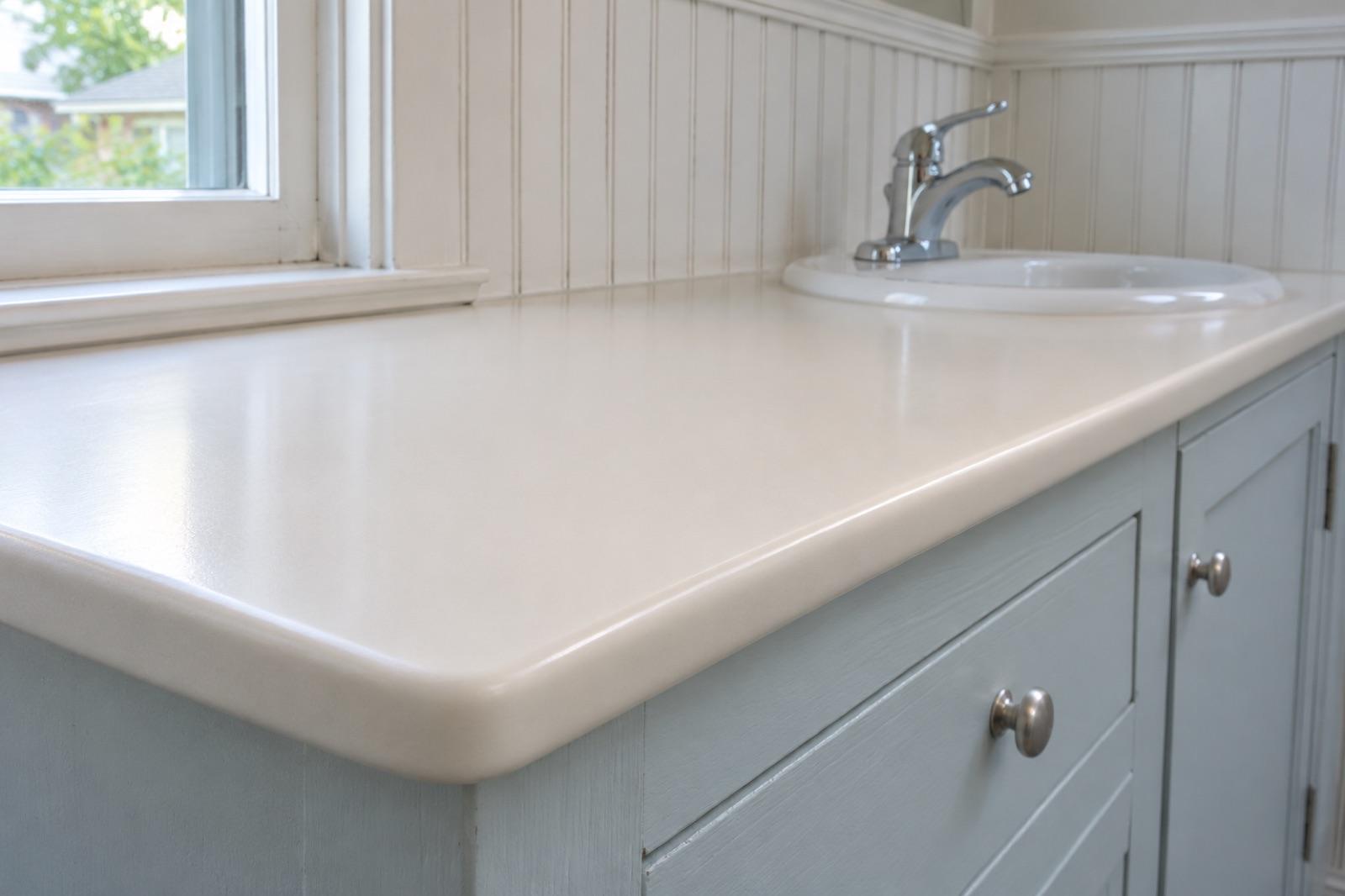
Corian and other solid surface
DuPont’s care guide calls Corian renewable because the color goes all the way through. It describes removing blotchy film, usually from hard water left to dry, and fine scratches with a mild abrasive cleanser, and minor cuts with abrasive pads; deeper scratches are best left to a professional refinisher. In harder-water areas such as parts of San Jose, where San Jose Water lists groundwater at 11 to 26 grains per gallon, that dried-water film is a common complaint.
Burns, cracks near a cooktop and cracked sink cutouts are repairs, not polishing, and are usually done by a fabricator or solid-surface repairer.
Tile and laminate counters
Tile and laminate counters cannot be honed or polished back, but they can be coated: Fixr lists $7 to $15 per square foot to paint and seal tile and $3 to $6 per square foot for a new laminate layer, and $4 to $8 for epoxy coatings over other surfaces. Coatings are cosmetic and wear faster than the original material under heavy use.
Fixr also notes that wood, stainless steel, zinc and epoxy counters are not well suited to this kind of refinishing.
When replacement makes more sense
Replace the counter if a stone slab is cracked through and moving, if laminate is delaminating or water-swollen at the sink, if tile is loose across the counter, or if the kitchen layout is changing.
Frequently asked questions
Can etched marble be fixed?
Yes, by honing and repolishing the etched area. Sealing does not prevent or remove etches.
Can a chipped granite countertop be repaired?
Usually. Chips are filled with color-matched resin and polished flush.
Can Corian be refinished?
Yes. Solid surface can be sanded and repolished because the color runs all the way through; deep damage is best left to a professional.
How much does countertop refinishing cost?
Fixr’s national range is $300 to $500, averaging about $400. Stone restoration is quoted after an inspection.
Who does the work?
Independent local contractors. This site passes your request to them; it does not employ a crew.