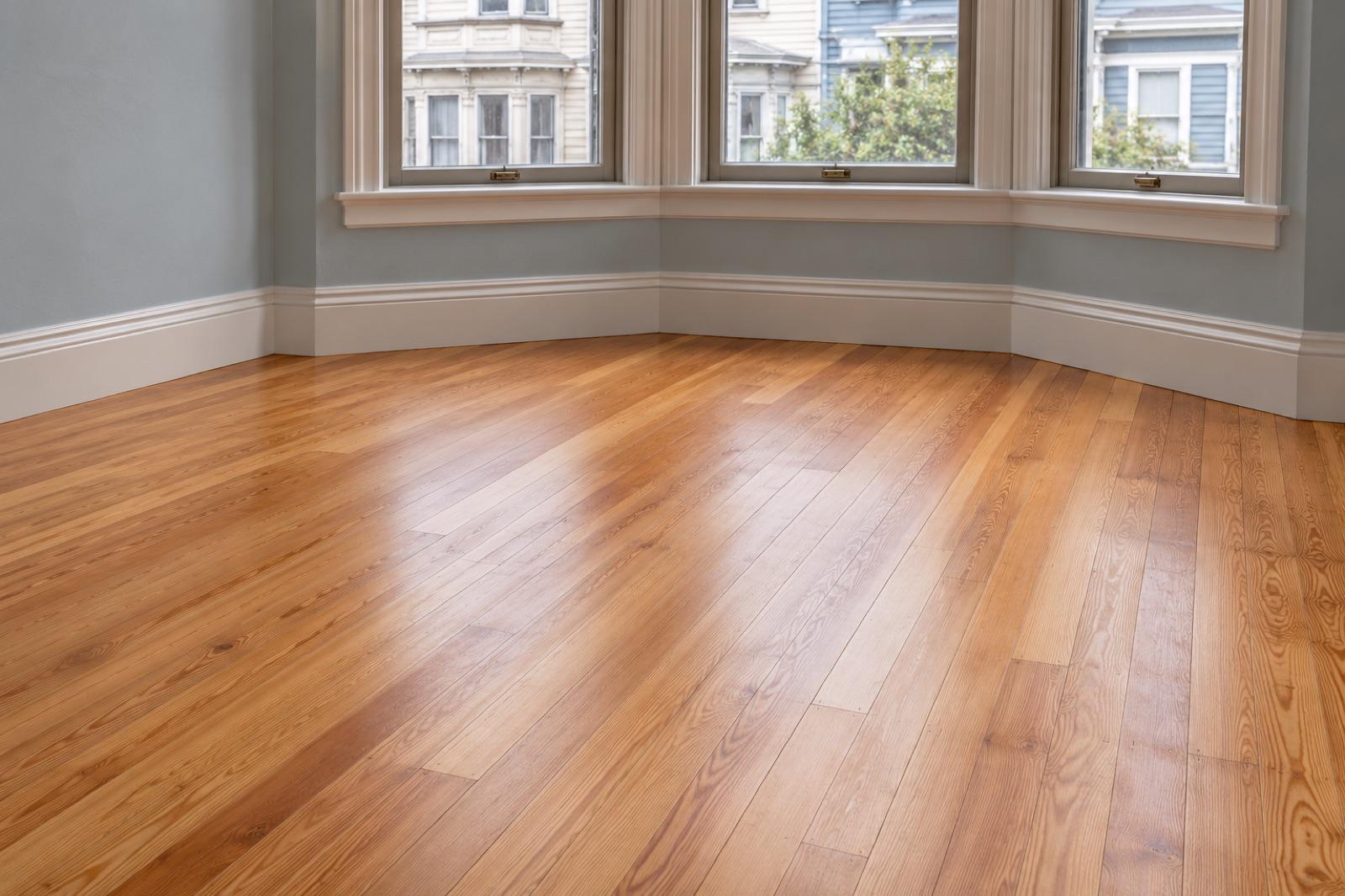
Sand and refinish, or screen and recoat
A full refinish takes the floor back to raw wood with a large drum or belt sander and an edger along the walls, working through progressively finer abrasives. Stain is optional. Then come several coats of finish; This Old House describes three coats as the standard process. This is what removes deep scratches, worn traffic lanes, old color and most surface stains.
A screen and recoat skips the sanding. A buffer with an abrasive screen or pad dulls the existing finish so a new coat can bond, then one fresh coat goes on. It suits floors whose finish is scuffed but intact. Fixr notes it only works on polyurethane floors that are not waxed, damaged or stained; it will not fix graying where the finish has worn through, and it will not bond over wax or many polish residues.
A simple test: if water beads on the worn lanes, the finish is still there and a recoat may work. If water soaks in and darkens the wood, the finish is gone in that area and sanding is the honest answer.
Oak, fir and what may be under the carpet
Older Bay Area houses commonly have one of two original floors: narrow oak strip, or Douglas fir. Oak is hard and forgiving to sand. Douglas fir is a softwood, so it dents and scratches more readily, and its grain can sand unevenly if the operator is heavy-handed. Refinishers who work on fir regularly will talk about lighter sanding passes and a harder finish.
Floors that have been sanded many times over a century can be thin. Before booking, look at board thickness where you can see an edge, such as a floor register opening or a threshold. Exposed nail heads or tongues showing between boards are signs that there is little wood left to sand.
If you are pulling carpet to find out what is underneath, look for tack strip damage, staple holes and pet stains at the edges of rooms; these affect whether boards need replacing.
Solid or engineered, and how many sandings it can take
Solid wood is the same species all the way through. According to the National Wood Flooring Association’s Hardwood Floors magazine, most solid floors can be sanded six to eight times over their life, with a typical sanding removing 1/32 to 1/16 inch.
Engineered flooring is a real-wood wear layer bonded to a plywood or composite core. NWFA puts wear layers between 1/16 and 1/4 inch and advises against sanding when the layer is under 3/32 inch (about 2.4 mm). Thin engineered floors are often limited to recoating. If you have engineered planks and do not know the product, a refinisher should check the wear layer in more than one spot before quoting a sand.
Raised foundations and moisture from below
Many older Bay Area houses sit on raised foundations with a crawlspace rather than a concrete slab. A damp crawlspace, a blocked vent or a plumbing leak can push moisture into the underside of the boards and make them cup, with edges higher than the centers. Sanding a cupped floor flat before the moisture is fixed can leave it crowned once it dries. If boards are cupped, find the moisture source first and let the floor settle.
Coast, bay and inland: seasonal gaps
Wood gains and loses moisture with the air around it. NWFA writes that wood floors perform best at 30 to 50 percent relative humidity and 60 to 80°F. Fog-belt neighborhoods tend toward the damp end; inland valleys run drier in summer, and heated houses run dry in winter. Thin gaps that open in the dry months and close again later are normal seasonal movement. Filling them with wood filler usually fails, because the filler gets squeezed out when the boards swell back.
Dust, lead and air rules
Dustless systems connect the sanders to a high-powered vacuum. Fixr says they cut dust but do not eliminate it, and This Old House prices dustless refinishing at $5 to $8 per square foot against $3 to $5.50 for standard sanding. They are worth asking about if you are living in the house during the work.
Floor finishes themselves are rarely the lead concern, but painted baseboards, stair risers and trim in a pre-1978 house can be. If those will be sanded or removed, the EPA’s Renovation, Repair and Painting rule applies to the contractor; ask about certification and containment, and see epa.gov/lead for health questions.
Floor finishes are also covered by the regional air district’s limits on volatile organic compounds in coatings (BAAQMD Regulation 8, Rule 3). Ask which product the refinisher uses and whether it meets those limits.
Finish choices
Oil-based polyurethane goes on with a warm amber tone that deepens over time, takes longer between coats, and has a stronger odor while curing. Water-based polyurethane dries clear, keeps pale woods pale, and allows faster recoats; two-component waterborne products are what many refinishers use for durability. Hardwax oils soak into the wood rather than forming a thick film, leave a low-sheen look, and can be spot-repaired, but they need periodic maintenance coats. Fixr lists hardwax oil from about $70 to $550 per gallon depending on the brand.
There is no single best finish. Pale fir and white oak often look closest to their natural color under waterborne finishes; owners restoring a period house sometimes prefer the warmer oil-based look.
How long rooms are out of use
This Old House puts a typical refinish at three to five days, depending on size, finish and humidity, and says to wait at least 48 hours before walking on it and several days before moving furniture back. As one product example, Bona’s data sheet for its Traffic HD waterborne finish says the floor can be walked on after 24 hours, is about 80 percent cured after one day and fully cured after three, and that rugs should wait until full cure. Oil-based products generally need longer. Follow the times your refinisher gives you for the specific product.
In a two-story house, plan the order of rooms so bedrooms are not cut off, and arrange somewhere for pets to stay while the finish cures.
When boards need repair or replacement
Sanding removes scratches and surface marks, but some damage is deeper. Black pet stains and long-standing water stains usually go right through the board, and boards that are split, soft or loose need replacing or refastening before sanding. Matching old fir or narrow oak can mean sourcing salvaged boards. This Old House lists repairs for deep scratches, gouges and loose boards at $6 to $12 per square foot, and Fixr puts full floor replacement at $14 to $32 per square foot, typically two to three times the cost of refinishing.
Price factors
National estimates: This Old House (2026) gives $3 to $8 per square foot and about $1,800 for an average project; Fixr (2025) gives $3 to $8 per square foot, with buffing and recoating at $1 to $2.50. These are not Bay Area quotes.
- Square footage, and whether stairs are included (Fixr lists $25 to $45 per step)
- Full sand versus screen and recoat
- Species: fir and oak sand differently
- Stain color, which adds a step and a day of drying
- Finish system: oil-based, waterborne or hardwax oil
- Board repairs, carpet and tack-strip removal, and moving furniture
Frequently asked questions
Can Douglas fir floors be refinished?
Usually, yes. Fir is softer than oak, so it needs careful sanding and a durable finish, and very thin, much-sanded fir may only take a recoat.
What is the difference between screen and recoat and refinishing?
A screen and recoat lightly abrades the existing finish and adds a new coat. Refinishing sands down to bare wood. Recoating cannot fix damage that has reached the wood.
How many times can engineered hardwood be refinished?
It depends on the wear layer. NWFA advises against sanding layers under 3/32 inch; thicker layers can take one or more sandings.
Is dustless refinishing really dust-free?
No. Vacuum-connected sanders cut dust substantially, but some still escapes. It costs more per square foot than standard sanding.
How soon can we walk on the floor?
It depends on the finish. This Old House suggests at least 48 hours; some waterborne finishes allow walking after 24 hours. Rugs should wait until the finish has fully cured.
Sources and further reading
- This Old House: How Much Does It Cost To Refinish Hardwood Floors? (updated June 5, 2026)
- Fixr: Hardwood Floor Refinishing Cost (updated January 31, 2025)
- Hardwood Floors magazine (NWFA): How Many Times Can a Wood Floor Be Sanded? (Brett Miller)
- Hardwood Floors magazine (NWFA): Technical Troubleshooting, Relative Humidity and Wood (Brett Miller, 2017)
- Bona Traffic HD technical data sheet, US edition (example waterborne floor finish; dry and cure times)
- U.S. EPA: Lead Renovation, Repair and Painting (RRP) program
- U.S. EPA: Lead (protect your family, renovation guidance)
- Bay Area Air Quality Management District: Regulation 8, Rule 3, Architectural Coatings