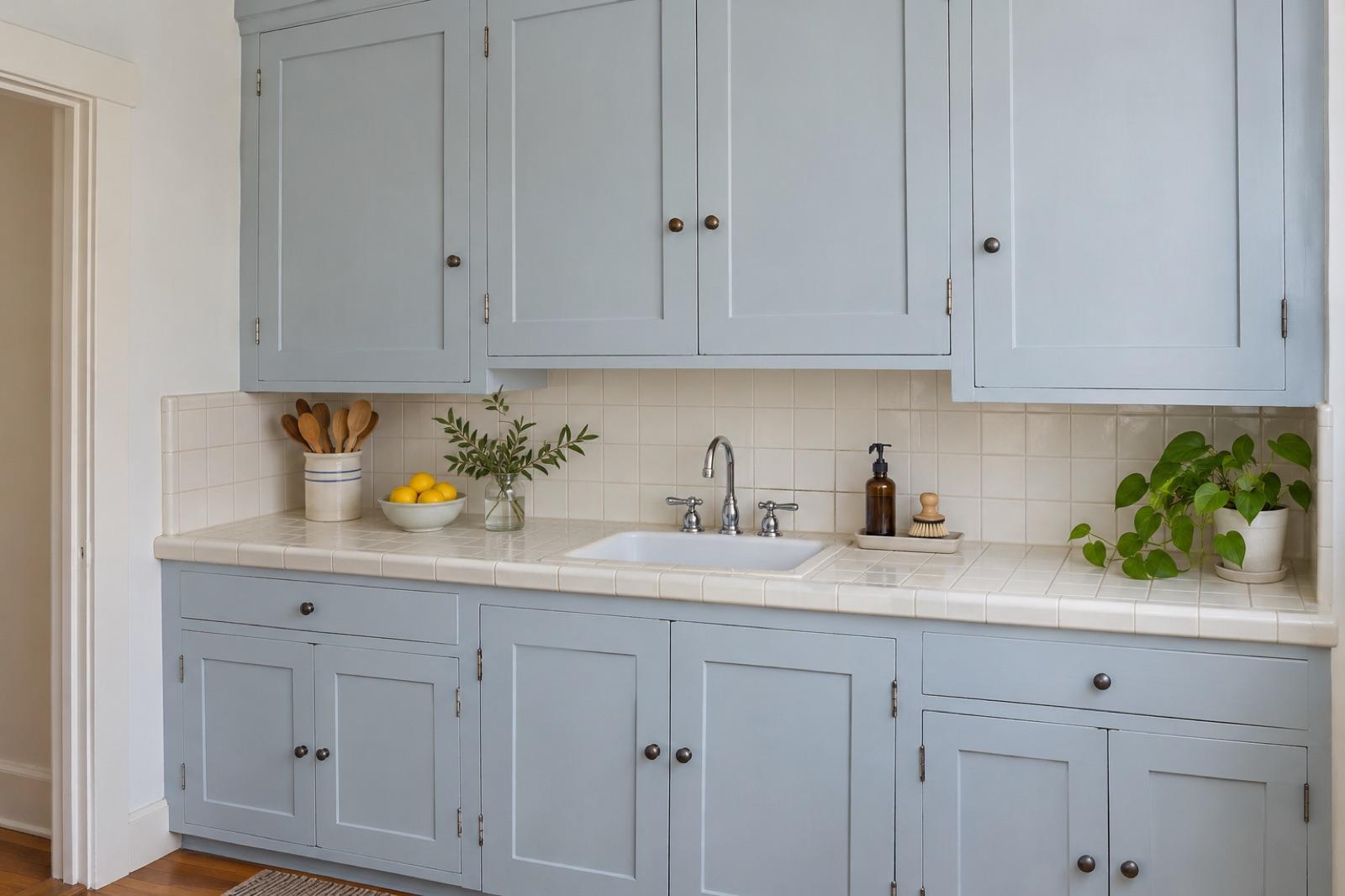
Four ways to update cabinets, in plain terms
Refinishing is the umbrella word. On stained wood it can mean stripping or sanding back the old clear coat, restaining and recoating. More often in practice it means painting: degreasing, sanding or deglossing, a bonding primer, then two topcoats of a cabinet-grade enamel, sprayed or brushed. Doors, drawer fronts, boxes and usually hinges all stay.
Refacing replaces what you see and keeps what you do not. The face frames and exposed box ends get a skin of wood veneer or laminate, and the doors and drawer fronts are replaced with new ones in a matching style. This Old House describes the veneer being glued and heated onto the frames, then trimmed and sanded. Pulls and hinges are normally new as well.
Painting alone, with the original doors, is the lowest-cost version of refinishing. Flat slab doors and simple shaker doors take paint well. Raised-panel or heavily routed doors can be painted too, but each groove is extra prep and the quote reflects it.
Replacement means new boxes. It is the only one of the four that can move a sink, add an island or change cabinet heights, and it tends to bring countertop, backsplash and sometimes plumbing work along with it.
Which cabinet materials can be refinished
What the cabinets are made of matters more than anything else. Open a door and look at its edge, then look inside the sink base, where the raw material is often visible.
- Solid wood (oak, maple, cherry, alder, or the fir found in some older built-ins): the best candidate for every option. It can be sanded, restained or painted, and dents can be filled.
- Wood veneer over plywood or particleboard: paints well and tolerates a light sanding, but a thin veneer can be sanded through, so restaining is risky. Lifting veneer edges have to be reglued first.
- MDF: paints very smoothly because it has no grain, but raw MDF edges drink primer and swell if water gets in, so damage beside the sink or dishwasher must be repaired or the part replaced before painting.
- Thermofoil (a vinyl film heat-formed over MDF): if the film is intact, some refinishers will prime and paint it; if it is peeling, bubbling near the oven or yellowed, new doors are the usual answer, often as part of refacing.
- Plastic laminate: can be painted over a primer made for slick surfaces, cannot be stained, and chipped laminate edges tend to show through paint.
What era is your kitchen?
The region’s housing spans more than a century, and the age of the house says a lot about what sits behind the cabinet doors. Berkeley grew from about 13,000 residents in 1900 to more than 82,000 by 1930 in U.S. Census counts, and many East Bay and San Francisco houses still have pantries or kitchens with site-built cabinetry from that period. It is often solid wood with painted face frames and inset doors, and decades of repainting can leave doors that bind and edges rounded over with paint build-up.
Fremont tells a different story. It was incorporated in 1956 from five towns (Centerville, Irvington, Mission San Jose, Niles and Warm Springs), and the following two decades brought fast housing growth. Kitchens from that wave, and from the remodels since, are more likely to have factory-built face-frame cabinets on plywood or particleboard boxes, which suit painting or refacing.
Mid-century modern houses are a category of their own. Joseph Eichler’s Rancho San Miguel tract in Walnut Creek dates from the mid-1950s, and there are Eichler neighborhoods on the Peninsula and in the South Bay too. Owners of these houses often want to keep the period look, which can tip the decision toward careful refinishing of original wood over paint or a refacing kit.
Lead paint in older kitchens
Paint applied before 1978 can contain lead, and cabinets in older Bay Area houses have often been painted several times. Sanding, scraping or heat-stripping those layers makes dust. Under the EPA’s Renovation, Repair and Painting rule, firms paid to disturb more than six square feet of painted surface per room inside a pre-1978 home must be certified and follow lead-safe work practices. Ask whether the firm is EPA Lead-Safe certified and how dust will be contained; a lead test before work starts removes the guesswork.
This is about how the job is done, not a reason to avoid it. For anything health-related, rely on the EPA’s guidance rather than this page.
Fog belt or inland valley
A finish behaves differently in the fog than it does over the hills. Near the coast and in western San Francisco, cool damp air slows drying, so a painter may need more time between coats and before doors go back on their hinges. Doors rehung too early can stick to their bumpers or take marks, a problem painters call blocking.
Inland valleys such as Walnut Creek and Concord get hotter, drier summers. Wood shrinks and swells with the seasons, and on painted solid-wood doors that movement can show as hairline cracks where rails meet stiles. That is normal wood behavior rather than a defect, but it is worth asking a painter how they treat those joints.
Coatings used here also fall under the Bay Area Air Quality Management District’s architectural coatings rule (Regulation 8, Rule 3), which limits volatile organic compound content. Ask which product will be used and confirm it is compliant for use in the district.
How long the kitchen is out of action
Most painters take the doors and drawer fronts away to spray them in a shop, or set up a spray area on site, then paint the frames and boxes in place. Counters get covered and the kitchen is a work zone while the boxes are coated, though you can usually still reach what is inside. Bob Vila’s guide gives one to three days for a professional refinish; drying time between coats and the number of doors decide the total, and the doors can be away longer than the boxes take.
Refacing usually takes less than a week according to Bob Vila’s refacing guide. Replacement takes longest, because demolition, new boxes, countertop templating and installation happen one after another.
What drives the price
For scale: Bob Vila (2023) puts typical professional refinishing at $1,500 to $5,000 with an average near $2,975, and notes that repairs, around $300 on average, are usually extra. For refacing, This Old House (2026) lists $4,500 to $13,000 for professional work and says it often runs 30 to 50 percent below the cost of new cabinets. These are national figures, so treat them as a sense of scale rather than a Bay Area quote.
- How many doors and drawer fronts there are, and their style
- Whether the existing finish needs stripping or only scuff-sanding
- Lead-safe containment in a pre-1978 house
- Repairs: water-swollen sink bases, loose face frames, missing shelves
- Paint versus a stain-grade refinish, and whether interiors are coated too
- New hinges and pulls, especially switching to concealed hinges
When replacing is the better call
New cabinets earn their price when particleboard boxes have swollen or come apart, when you need a different layout or more storage, or when the kitchen is being gutted for plumbing or electrical work anyway. A period kitchen with sound original cabinetry is the opposite case: matching that work new is expensive, so price a careful refinish first.
Frequently asked questions
Is refacing or painting cheaper?
Painting is usually cheaper because nothing is replaced. Refacing adds new doors, drawer fronts and veneer, so it costs more, but it changes the door style, which paint cannot do.
Can oak cabinets be painted without the grain showing?
Oak has open grain that shows through paint. Painters who want a smooth look fill the grain before priming; ask whether that step is in the quote.
Do I need to worry about lead in an older Bay Area kitchen?
If the house was built before 1978, old paint may contain lead. Ask for an EPA Lead-Safe certified firm and follow the EPA guidance at epa.gov/lead.
Can thermofoil doors be refinished?
Intact thermofoil can sometimes be primed and painted. Peeling or bubbled thermofoil generally cannot be painted over reliably, and replacing the doors is the usual fix.
Will I be without a kitchen?
Usually only partly. Doors are often taken away to be sprayed while the boxes are painted in place, so the room is a work zone for several days but the cabinets stay in use.
Sources and further reading
- Bob Vila: How Much Does It Cost to Refinish Cabinets? (updated February 22, 2023)
- Bob Vila: Cabinet Refacing: What Does It Really Cost? (updated May 1, 2024)
- This Old House: Cabinet Refacing: Everything You Need to Know (updated June 5, 2026)
- U.S. EPA: Lead Renovation, Repair and Painting (RRP) program
- U.S. EPA: Lead (protect your family, renovation guidance)
- Bay Area Air Quality Management District: Regulation 8, Rule 3, Architectural Coatings
- Washington Township Museum of Local History: Fremont, The New City 1956 to 1976
- Eichler Network: The Eichlers of Rancho San Miguel, Walnut Creek
- U.S. Census Bureau: Decennial Census by Decade (historic city population counts)